Overview of Political Instability in Africa
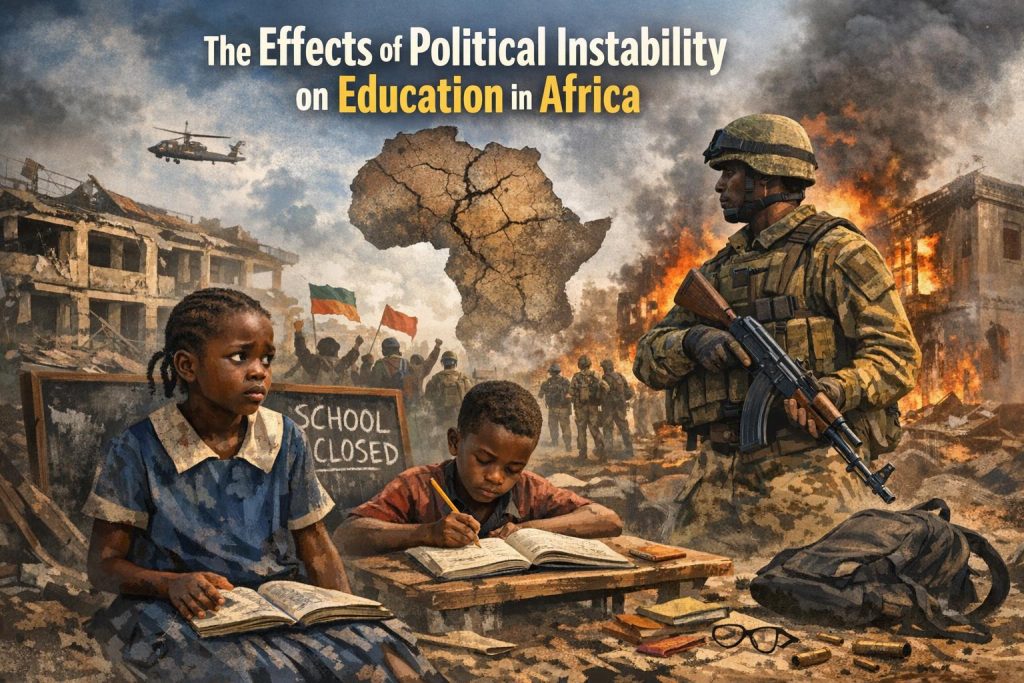
Political instability in Africa takes multiple forms, including military coups, contested elections, civil conflicts, and prolonged states of emergency. While the intensity and frequency of such events vary across countries, instability remains a persistent factor influencing governance and public service delivery. Education systems are particularly sensitive to political disruption because they rely on consistent funding, administrative continuity, and physical security.
According to data from the World Bank, countries experiencing prolonged instability often show weaker education outcomes compared to more politically stable states. These outcomes include lower enrollment rates, reduced literacy levels, and gaps in educational attainment between regions.
Disruption of School Operations
Political unrest often leads to the temporary or prolonged closure of schools. Armed conflict can damage school infrastructure or convert buildings into shelters or military facilities. In situations of electoral violence or state-imposed curfews, schools may suspend operations for extended periods.
The UNICEF has documented cases in several African countries where insecurity has interrupted academic calendars for months or even years. When closures occur frequently, students face interruptions in learning continuity, which affects progression rates and examination performance.
In rural or conflict-affected areas, reopening schools can be delayed due to insecurity, displacement of teachers, and lack of rehabilitation resources. These interruptions contribute to long-term educational gaps.
Case Studies of School Disruptions
Examining specific instances of school disruptions provides insight into the broader impact of political instability. For example, in Nigeria, the ongoing conflict with Boko Haram has led to the destruction of numerous schools, particularly in the northeastern regions. Many educational institutions have been forced to close indefinitely, depriving thousands of children of their right to education.
In South Sudan, a nation grappling with civil war since its independence, educational facilities have frequently been targets of violence. Schools are often caught in the crossfire during conflicts, and many families are hesitant to send their children back to school even when they reopen due to prevailing security concerns. Similar circumstances are observed in other regions, emphasizing the vulnerability of the education sector during political upheaval.
Effects on Educational Infrastructure
The direct impact on educational infrastructure is a significant concern. Political instability often leads to extensive damage to school buildings, libraries, and other facilities necessary for learning. Remodeling and reconstructing these infrastructures demand substantial funds and efforts, which are often limited in conflict-affected areas.
Moreover, the unstable environment means that even newly reconstructed facilities may be at risk of further damage. As a result, not only does the immediate education of children suffer, but future prospects are also hindered by the lack of long-term planning and development in the education sector.
Impact on Education Funding
Stable governance structures are essential for predictable budget planning. During periods of political instability, governments may redirect public spending toward defense or internal security. This can result in reduced allocations for education infrastructure, teacher recruitment, and curriculum development.
In fragile states, public revenue collection may decline due to economic contraction or administrative breakdowns. As a result, education systems can experience shortages of learning materials, delayed teacher salaries, and limited maintenance of school facilities.
Challenges in Education Financing
The diversion of funds from education to security and defense is a pattern that has been observed in many African countries undergoing political unrest. In such conditions, education is often placed on the back burner, with attention focused on immediate and pressing security needs. The outcome is often a drastic reduction in government expenditure on education.
Further compounding these issues is the challenge of deteriorating economic conditions often associated with unstable political environments. Economic shrinkage reduces government revenue, leading to further budgetary constraints. The education sector becomes one of the hardest-hit domains in such scenarios.
Role of International Aid
International funding can help offset domestic shortfalls. Organizations such as the Global Partnership for Education provide financial support to countries affected by fragility and conflict. However, aid flows are sometimes unpredictable and may depend on improvements in governance and transparency.
This reliance on international aid presents another layer of complexity. While it brings in necessary financial resources, dependence on external support can create vulnerabilities, especially if aid is contingent on certain political or governance benchmarks. Countries struggling with instability may find it difficult to meet these conditions, leading to uncertain aid flows.
Teacher Retention and Workforce Stability
Teachers are directly affected by political instability. In conflict zones, educators may flee to safer regions or neighboring countries. This migration reduces the availability of qualified personnel, particularly in specialized subjects such as mathematics and science.
Challenges in Teacher Recruitment and Retention
Irregular salary payments are another factor contributing to workforce instability. When governments experience administrative disruptions, payroll systems may be delayed or suspended. Over time, this weakens morale and reduces incentives for skilled professionals to remain in the sector.
Teacher training institutions may also face operational challenges, leading to a slowdown in the preparation of new educators. The combined effects contribute to larger class sizes and diminished instructional quality.
Impact on Professional Development
With the education sector destabilized, ongoing professional development for teachers is often neglected. Political unrest can close training colleges or limit their operational capacity, making it difficult to maintain the quality of education through adequately trained personnel.
The resultant skills gap within the teaching workforce can have lasting effects on the quality of education. As education suffers, the ability to prepare future professionals in various fields declines, perpetuating a cycle of underdevelopment and stagnation in societal growth.
Access and Inequality
Political instability often exacerbates existing inequalities. Urban areas typically recover more quickly than rural or conflict-prone regions. As a result, disparities in access to education can widen.
Girls and marginalized groups face heightened risks during instability. Security concerns and displacement may reduce school attendance, particularly where long travel distances are involved. In refugee or internally displaced persons (IDP) camps, access to formal schooling is often limited or dependent on humanitarian programs.
Barriers to Educational Access
The United Nations High Commissioner for Refugees reports that displaced children in Africa have lower enrollment rates compared to national averages. Interrupted schooling during displacement can have lasting impacts on literacy and employment prospects.
Additionally, in many conflict-affected regions, the educational prospects for girls are further diminished due to cultural norms and safety concerns that restrict their access to schooling. Often, the burden of household responsibilities also falls more heavily on girls, reducing their opportunities for education.
Role of Social and Economic Disparities
Social and economic disparities, coupled with political instability, create an environment where education becomes a resource accessible to fewer individuals. In crisis situations, resources are limited and generally allocated to more immediate needs, leaving vulnerable groups with reduced support for educational endeavors. This reinforces existing inequality and perpetuates cycles of poverty within marginalized communities.
Long-Term Economic Consequences
Education plays a central role in human capital development. When political instability disrupts learning systems, the long-term effects extend beyond individual students. Lower educational attainment can reduce workforce productivity and limit economic diversification.
Impact on Economic Development
Research consistently shows a correlation between years of schooling and income growth. Countries facing recurrent instability may experience slower human capital accumulation, which can constrain national development. In this context, education both influences and is influenced by political stability.
The broader economic implications are profound. An educated population typically supports innovation, drives economic growth, and fosters societal development. Conversely, a society with limited educational prospects struggles to achieve these advancements, perpetuating cycles of economic hardship.
Consequences for Civic Engagement
A weakened education system can also affect governance outcomes. Limited civic education and lower literacy rates may reduce political participation and institutional accountability, reinforcing cycles of instability.
The absence of a well-informed citizenry diminishes the ability to challenge governance structures, demand transparency, and promote democratic ideals. As such, weakened education systems often correlate with diminished civic consciousness and engagement, further entrenching instability.
Policy Responses and Mitigation Strategies
Governments and regional institutions have implemented strategies to protect education during crises. These include integrating education in emergencies frameworks, establishing temporary learning spaces, and investing in digital or radio-based instruction when physical attendance is not possible.
Implementing Emergency Education Solutions
Examples of these adaptive strategies include the establishment of mobile learning units and the use of technology to bridge educational gaps. Such initiatives can help sustain learning even in unstable environments, though their effectiveness depends on the availability of resources and infrastructure.
The African Union has supported continental initiatives aimed at strengthening governance and conflict prevention, recognizing the link between stability and educational progress. At the national level, policies that decentralize school management can sometimes help maintain service delivery during periods of central political disruption.
Building Institutional Resilience
Sustained improvement depends on strengthening institutions, ensuring transparent budgeting, and protecting schools from military use. International cooperation remains an important component, but domestic political commitment is central to long-term resilience.
Efforts to support institutional resilience focus on enhancing administrative capacities and fostering greater local control over education. By building robust local education networks, countries can better withstand national-level political disruptions and continue to deliver educational services.
Conclusion
The effects of political instability on education in Africa are multifaceted, influencing infrastructure, funding, workforce stability, and equitable access. While the degree of impact varies by country, consistent patterns show that instability disrupts learning continuity and weakens institutional capacity. Strengthening governance systems and safeguarding education during crises are key measures for improving long-term educational outcomes across the continent.
Efforts to address these issues must consider both immediate needs and long-term development goals. By focusing on sustainable solutions and fostering robust international cooperation, Africa can enhance its educational systems and resilience in the face of political instability.