South Africa offers a broad choice of universities, from large research institutions in major cities to smaller universities where campus life shapes much of the surrounding town. Students can pursue qualifications in medicine, engineering, business, law, agriculture, the arts and many other subjects, with opportunities extending from undergraduate study to doctoral research.
Choosing between South African universities involves more than comparing their positions in international rankings. The content of a degree, admission requirements, teaching facilities, accommodation and total cost of attendance all deserve attention. For postgraduate students, the availability of a suitable supervisor can matter more than the reputation of the university as a whole.
The following overview introduces eight notable universities in South Africa, covering their history, academic offerings and study environments. It is a starting point for comparing institutions rather than a ranked list.
University of Cape Town (UCT)
Situated on the slopes of Table Mountain, UCT traces its origins to the South African College, founded in 1829. It became a fully established university in 1918. This distinction separates the institution’s early educational history from the date it acquired university status.
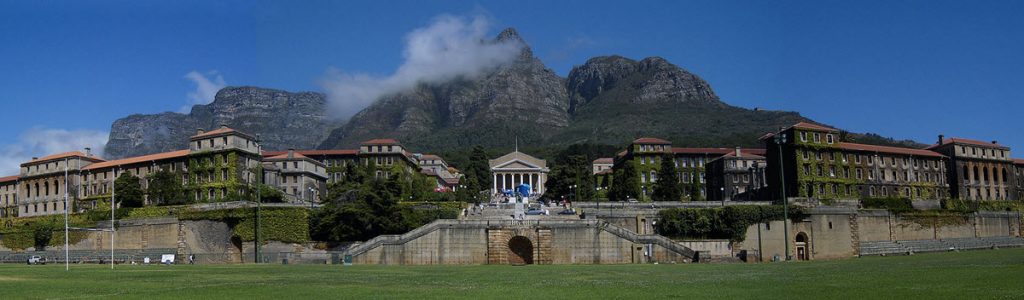
UCT has six faculties: Commerce, Engineering & the Built Environment, Health Sciences, Humanities, Law and Science. Students can follow undergraduate degrees, postgraduate diplomas and research qualifications, although the available routes and entry requirements differ between departments. Its range of subjects makes it possible to compare several academic directions within one institution.
For prospective students, the appeal extends beyond the university’s setting. A research degree involves identifying an appropriate department, a feasible project and a supervisor with relevant expertise. Undergraduate applicants should examine compulsory modules and the subjects needed for admission, particularly for degrees with substantial mathematics or science content.
Accommodation and transport deserve early planning. Applicants should establish where their teaching takes place and compare residence options with private accommodation. A room that looks affordable can become less practical once daily travel costs and commuting time are included.
Stellenbosch University (SU)
Located in the Western Cape’s wine region, Stellenbosch University became a university in 1918, building on earlier institutions including Victoria College. Its main campus sits within Stellenbosch itself, giving students a university experience closely connected to the town’s streets, businesses and cultural venues.
Stellenbosch offers subjects across the sciences, engineering, business, humanities and professional disciplines. Its agricultural programmes include viticulture and oenology, which concern grape cultivation and winemaking, alongside forestry, wood sciences and conservation ecology. These subjects illustrate how a university’s teaching can connect with the industries and environments around it.
The university also has a history of engineering research. SUNSAT, developed at Stellenbosch and launched in 1999, was the first satellite built in Africa. Projects of this kind demonstrate the connection between academic research and practical technical development, although participation in particular projects depends on the department and level of study.
Stellenbosch students are commonly known as Maties. Campus traditions, societies and sport contribute to student life, but applicants should give equal attention to practical matters such as accommodation and teaching arrangements. Students should check the language arrangements for their chosen programme directly rather than assume every course follows the same format.
When comparing Stellenbosch with other universities, examine the actual curriculum. Two degrees with similar titles may offer different combinations of laboratory work, fieldwork, electives and research. Those differences can influence both the experience of studying and the options available after graduation.
University of the Witwatersrand, Johannesburg (Wits)
The University of the Witwatersrand, usually called Wits, is based in Johannesburg. Its origins lie in the South African School of Mines, established in Kimberley in 1896. The institution moved to Johannesburg in 1904 and acquired full university status in 1922.
Its mining heritage helps explain its longstanding connection with engineering and industry, but modern Wits offers a much wider academic range. Its five faculties cover Commerce, Law and Management; Engineering and the Built Environment; Health Sciences; Humanities; and Science. Students can pursue professional qualifications as well as academic and research degrees.
Johannesburg provides an urban setting for university life. Studying in a major commercial centre can make it easier to attend professional events, investigate employers and build contacts beyond campus. However, location alone does not guarantee an internship or graduate job. Students still need to develop relevant skills and apply for opportunities.
Applicants should compare the demands of individual programmes carefully. Engineering, health sciences and other professional degrees can involve structured timetables, practical training and progression requirements. Humanities and science degrees may offer different kinds of subject choice. Understanding those arrangements before enrolling helps students judge whether a course suits their interests and working habits.
University of Pretoria (UP)
Established in 1908, the University of Pretoria offers teaching and research across a broad selection of disciplines. These include engineering, economics, management, education, law, health sciences, humanities and natural and agricultural sciences.
Veterinary science is a particularly distinctive part of its academic offering. UP houses South Africa’s only Faculty of Veterinary Science, based at Onderstepoort. The field brings together animal health, clinical practice, disease prevention and research, with connections to agriculture, wildlife and public health.
Students considering veterinary or other professional programmes should investigate the practical demands of training as well as academic admission standards. Clinical work, placements and compulsory practical activities can affect timetables, travel and the overall length of a qualification.
UP operates across several campuses, making the location of a particular programme relevant when choosing accommodation. Applicants should establish where lectures, laboratories and practical sessions take place before committing to a residence or rental agreement. For postgraduate study, reviewing departmental research interests is a useful next step after identifying a suitable degree.
University of KwaZulu-Natal (UKZN)
The University of KwaZulu-Natal was formed in 2004 through the merger of the University of Natal and the University of Durban-Westville. Its history therefore includes the academic traditions of both predecessor institutions.
UKZN operates across five campuses: Edgewood, Howard College, the Nelson R. Mandela School of Medicine, Pietermaritzburg and Westville. These locations serve different academic purposes, so applicants should not assume that every subject is available on every campus. The campus attached to a degree will shape accommodation choices and everyday travel.
The university offers study in areas including health sciences, agriculture, engineering, education, law and the humanities. Its research environment includes work on HIV and tuberculosis, alongside agricultural and environmental subjects. These fields connect university research with challenges affecting communities in KwaZulu-Natal and beyond.
Applicants interested in research should look beyond a broad subject label. Public health, for example, can involve laboratory science, clinical investigation, population research or health policy. Reading departmental descriptions and potential supervisors’ work helps identify which approach matches a proposed project and existing qualifications.
Rhodes University
Rhodes University is located in Makhanda, formerly known as Grahamstown, in the Eastern Cape. Founded as Rhodes University College in 1904, it became an independent university in 1951. Its smaller setting offers a different experience from studying at a large university spread across a major city.
Rhodes offers programmes through faculties including Humanities, Science, Commerce, Law, Education and Pharmacy. Journalism and media studies form a prominent part of its academic identity, while its humanities teaching also includes fine art, languages and literature.
The School of Journalism and Media Studies combines academic examination of the media with professional practice. For applicants interested in journalism, it is useful to compare the balance between reporting, production, media theory and research. A course should develop the ability to question information and understand audiences, as well as familiarity with production tools.
A smaller university may appeal to students who prefer a more concentrated campus community. It should not, however, be taken as a guarantee of small classes in every subject. Prospective students should ask about teaching formats, residence availability and academic support within the department they intend to join.
University of the Western Cape (UWC)
Based in Bellville, Cape Town, UWC has a history closely connected to South Africa’s struggle over access to education. Legislation establishing the institution was adopted in 1959, and its first students enrolled in 1960. It gained university status in 1970.
The apartheid government originally created the institution for students classified as “Coloured”. UWC subsequently became an important centre of opposition to apartheid. Its commitment to access, equity and social justice grew from that history and remains part of its institutional identity.
Its academic offering includes arts and humanities, education, law, economic and management sciences, natural sciences, community and health sciences, and dentistry. Public health and dental education provide examples of disciplines where teaching, research and the needs of surrounding communities can intersect.
Students considering UWC should investigate the structure of their preferred qualification and the support available during study. Those entering health professions should also establish where clinical teaching takes place and what practical commitments it involves. For commuters, the cost and reliability of daily transport deserve as much attention as tuition fees.
Nelson Mandela University (NMU)
Nelson Mandela University has its main base in Gqeberha, formerly Port Elizabeth, and also operates in George. It was established as Nelson Mandela Metropolitan University in 2005 through a merger involving the University of Port Elizabeth, Port Elizabeth Technikon and the Port Elizabeth campus of Vista University. It adopted its present name in 2017.
This combined heritage helps explain its mixture of academic degrees and professionally oriented qualifications. Study areas include engineering, business, education, health sciences, law, science and the arts. Applicants should compare the purpose and progression routes of individual qualifications rather than assume that every course follows the same academic model.
Ocean and coastal research are notable parts of the university’s work. Its Ocean Sciences Campus houses research activity connected with marine and coastal environments. Students interested in these subjects should distinguish between undergraduate preparation and the more specialised projects available through postgraduate research.
As with other universities operating across several locations, checking the teaching campus is an early priority. Programme information should also clarify whether practical placements, studio work, laboratory sessions or field activities form part of the qualification.
Choosing a University in South Africa
Start with the subject you want to study and the qualification you need. Compare compulsory modules, elective options and assessment methods before focusing on campus appearance or reputation. Applicants planning a professional career should check that the particular qualification meets the relevant educational requirements for their intended career and destination.
Budget for the full period of study. Tuition is only one expense: accommodation, food, transport, learning materials and practical equipment can also affect affordability. Ask whether funding covers living costs and whether accommodation requires a separate application. Meeting a university’s academic entry requirements does not automatically secure funding or a residence place.
International applicants should contact the university about recognition of their school or university qualifications, language requirements and the documentation needed before registration. Application dates can differ between programmes, and courses with selection procedures may require additional steps. Use the relevant university’s current admissions information rather than relying on an older prospectus.
For postgraduate applicants, the comparison should become more focused. Examine supervision, research facilities, funding duration and whether the degree is mainly taught or research based. The most suitable university is the one that offers an appropriate course, a workable financial plan and the academic support needed to complete it.